

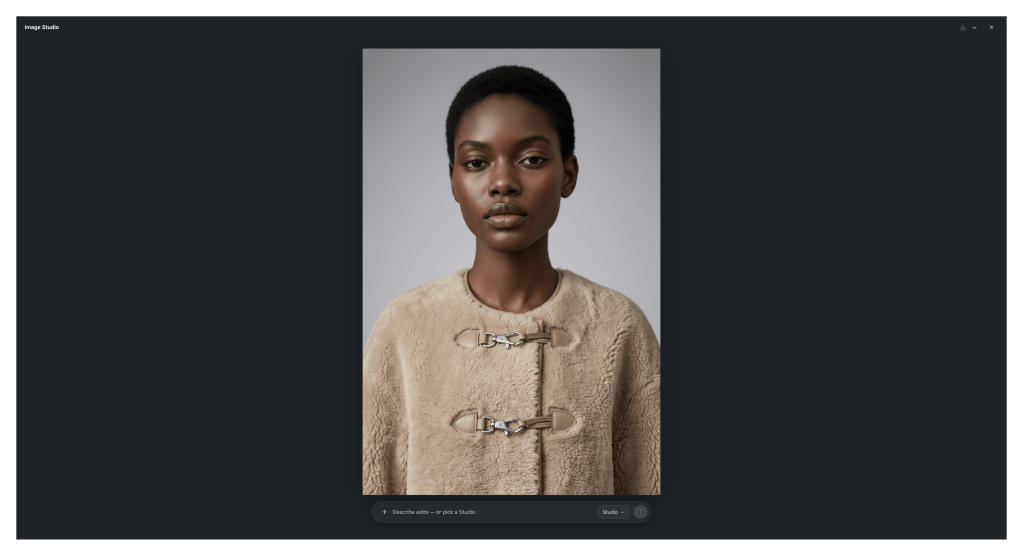
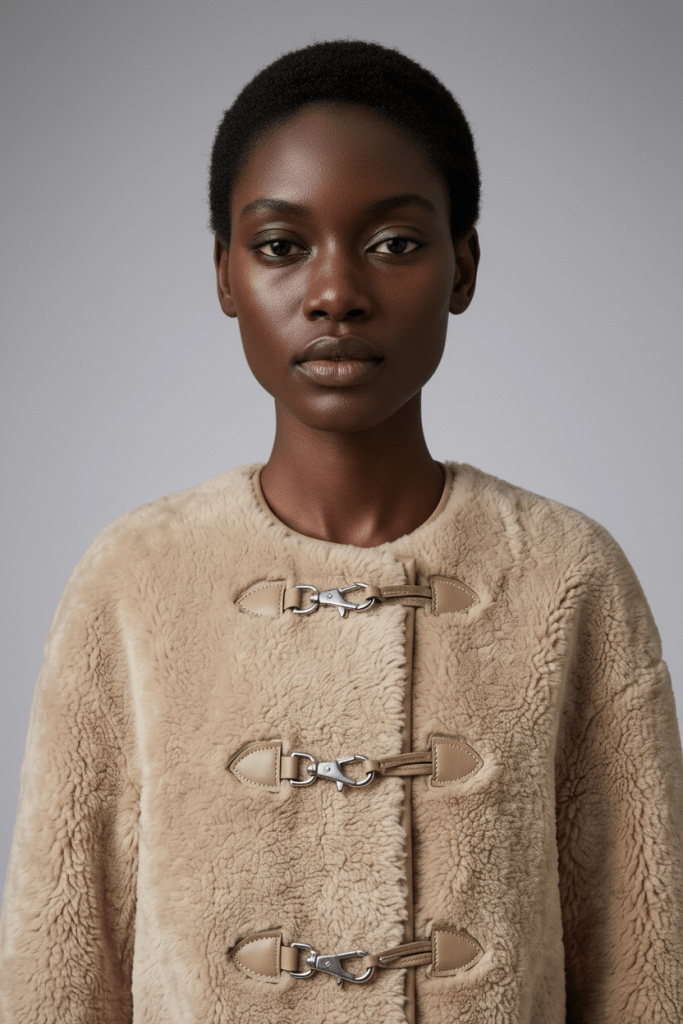
I’m a designer, and I decided to be overly ambitious™: build an AI image plugin for WooCommerce, make it production-grade, and—while I was at it—build a vision-language-model judges lab. Who likes an easy life, anyway?
It was hard, and sometimes frustrating. But I’ve never felt happier or more in the flow than I did on this project. And I’ve never learned faster.
Last year I wrote an internal post arguing that we don’t just build products—we build trust. I didn’t know then that I’d end up building software whose job is to check for it.
So, what happened?
A few weeks ago I ran a merchant interview, showing what the plugin could do with product photos: new scenes, new light, all of it. The merchant leaned in, but not for the scenes. She was squinting at the coffee cup, checking whether the tiny droplets of condensation had survived. They had.
Tiny things a model can easily decide are irrelevant: a zipper, a logo, the texture of a knit, except they’re not irrelevant if it’s your product.
That squint is the whole story, but it starts a few months earlier.
The post I almost didn’t write
Earlier this year, Automattic ran a one-month Radical Speed experiment. Pick whatever you want to build and go for it. Just find yourself a partner to pair with.
I already knew that merchants struggle with product images. Good photography is expensive, and most stores are one person and a phone. So I proposed the ambitious version: an AI image editing plugin for WooCommerce—a real one, not a prototype.
Plenty of people told me it was a lot. But somehow, the more ambitious a thing is, the more interested I become.
First, I tested it technically and proved it could actually work. Before that, I had no idea whether it was even achievable in a month. If it hadn’t worked, there would have been no post. Once I saw it was possible, I wrote the proposal post, without much hope that anybody would pair with me.
To my surprise, my colleague Paul Maiorana left such an in-depth comment about the problem that I asked if he wanted to join me in solving it. He did. My instinct was to build and test the technology in every direction possible; his was to keep asking what a merchant would actually reach for. Together we narrowed it all down to three things: Studios, Scenes, and Models.
Then I just kept building
A while ago I wrote an internal post on a company P2 about shipping my first PR ever. This project is what happened when I just didn’t stop. The one-month experiment is now past 200 PRs, and it runs on our production infrastructure.
Woo Image Studio lives right on the product image in the product edit screen. One click: reshoot your product on a clean surface, place it into a styled scene, or see it worn by a model. Type what you want in a free-form editor.
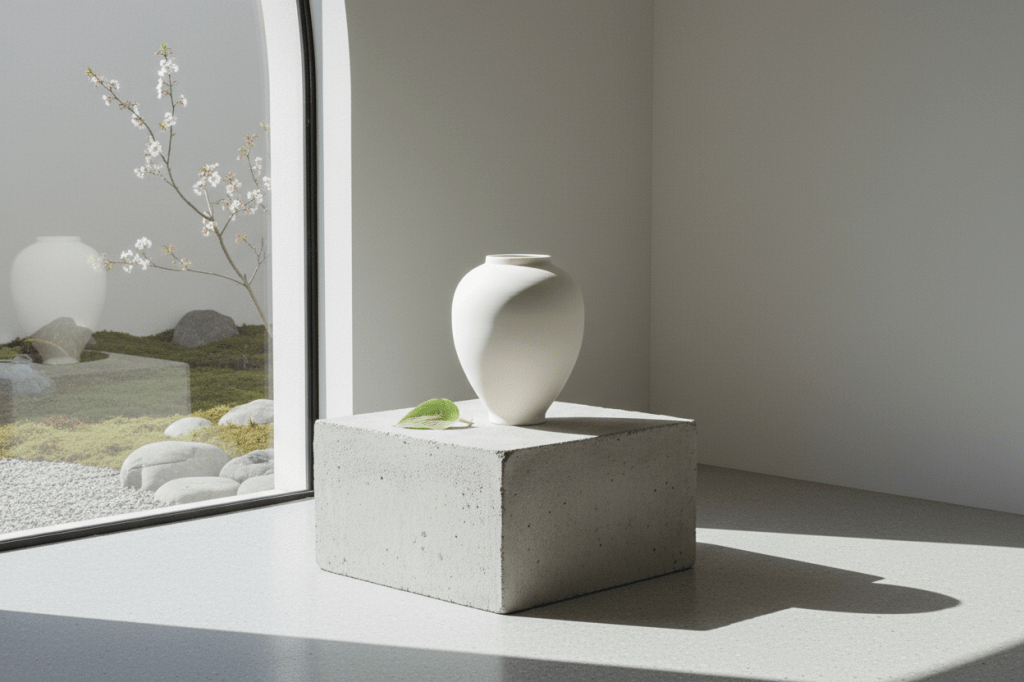
And underneath it all, two rules I would defend against anyone:
- The original image is never touched. Every generation is a new attachment; replace and revert are one click each.
- There is nothing to configure. No API keys, no AI model pickers; presets instead of prompts in the main UI. Requests are signed through the site’s WordPress.com connection and routed through our AI infrastructure. You click the thing and it just works.
That second rule sounds like an engineering detail, but it’s a design one. Hold that thought.
The question I couldn’t answer by looking
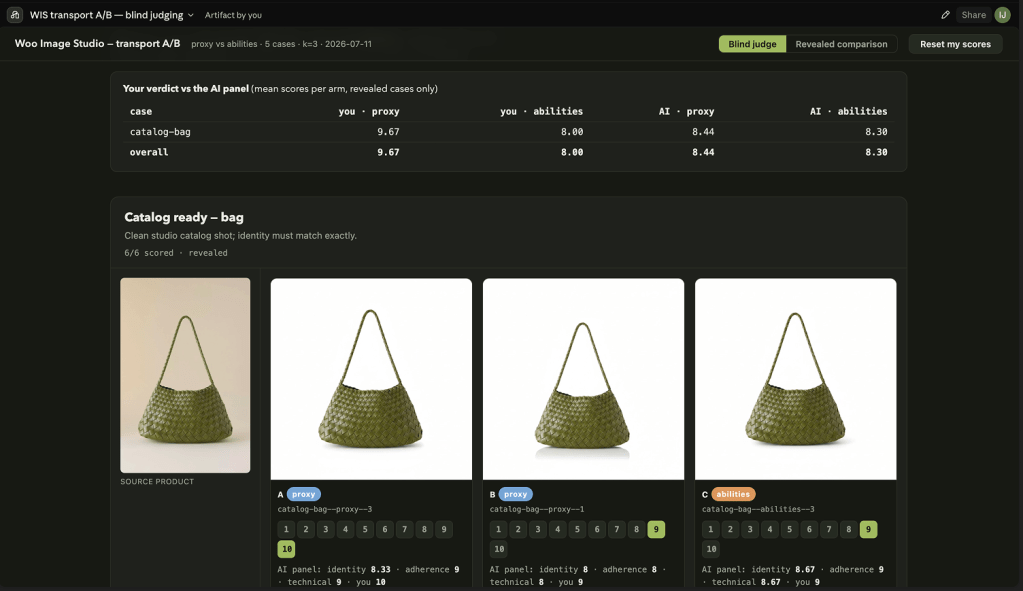
Somewhere in the middle, I ran into a surprisingly difficult question: how do I actually know if the output is good? How do I know we’re not slowly losing the product along the way?
Looking at images myself works when there are five of them. It works much less well across models, prompts, and hundreds of outputs: when you want to know whether the thing you changed yesterday made something else worse today.
So, naturally, I built an evaluation harness. Then I experimented with vision-language-model judges. Eventually this became a little VLM judges lab: a golden set of real product photos runs through the recipes merchants would use, and a judge grades every output side by side with the original photo, on one question: is this still the same product?
And I couldn’t just take the judge’s word for it: I hand-labeled 137 outputs and calibrated the judge against my own labels, so I would know where to trust it and where not to.
So now an A/B between two models ends in a sign test, with blind judges grading the outputs. One of the first things it told me was that a change I was certain about did nothing.
Back to the coffee cup
Then came the merchant interviews, and the thing that reframed the whole project.
I was curious whether people would use AI-generated images for their products at all. Generating a beautiful image is easy now. But would you put it in your store, on your product page? That’s a different question.
What surprised me was how much trust came down to the smallest things. The squinting merchant, with a decade’s experience of selling vintage items, ended up trusting the tool precisely because the droplets survived: a detail she knew AI could easily wipe out.

Another watched a plush hedgehog stay recognizably itself across scene after scene, and said that consistency was what kept the images from looking fake. A third asked for one tiny edit, saw that only that one thing changed, and relaxed.
Merchants weren’t opposed to generated images. They trusted the outputs more than I expected. What they needed to trust was more specific: that while we were changing the image, we weren’t quietly changing their product. The vintage seller sells items where every dent matters, because every dent is the product.
Merchants needed to trust that while we were changing the image, we weren’t quietly changing their product.
It’s only a handful of interviews so far, but it all points the same way: the hard part isn’t generating images, it’s getting a merchant to trust them.
And suddenly my judges rabbit hole made sense. The judge was there to catch exactly these tiny things, systematically: the droplets, the logos, the dents.
Last year I wrote an internal post arguing that we don’t just build products—we build trust. I didn’t know then that I’d end up building software whose job is to check for it.
Demo vs. product
There is one more thing I apparently care about more than I realized: I don’t like throwaway things.
An impressive AI demo is cheap to build now. With agents writing most of the code, I can have a convincing prototype in an afternoon. But there is an enormous distance between “look, it works!” and “here, you can actually use it.”
I know how wide that distance is, because I rewrote the backend three times. Each time, something I had learned about the real production infrastructure made the previous version a dead end. With agents, the rewriting itself was fast. What they couldn’t do was tell me the architecture was wrong. That was on me.
And if the goal is to hand this to a merchant and solve their problem, then handing them a technical problem first isn’t much of a solution. So a large part of the project became the unglamorous half of trust: keeping API keys out of the product entirely, security, failure handling, costs, tests, reproducible builds. Believing the zipper or the logo survived is only half of it; the plugin also has to work, every day.
There’s something satisfying about taking a thing from technically possible to actually usable. I think I might like that part even more now.
So am I still designing?
I’ve been turning over this question the entire time. As a designer, I spend much less time in Figma now; I recognize that. I write code, review PRs, build evaluation systems. And I see how that doesn’t sound like the job description I would have given a product designer a few years ago.
But I don’t think I stopped designing. Look at where the design decisions in this project actually landed.
Some of the decisions are classic UI and UX: what the picker shows, what stays hidden, what one click means, whether you should have to type a prompt at all.
Others don’t look like design from the outside. When a scene recipe needs to keep a product’s proportions honest, the fix is changing how we talk to the model. And the judge rubric is me writing down what “good” means.
The biggest simplification in the product is “merchants never see an API key,” and it shows up as an absence: a settings page that doesn’t exist. Making that page unnecessary took a lot of work.
The instinct is the one I’ve always had: obsessing over tiny details and where people get confused. What expanded is the canvas.
And I really, really like that.
If you’re a designer wondering whether there’s still room for your obsession with craft, this whole project runs on it. And if the technical side puts you off, I’m not a technical person, and this project exists anyway.
If you build something, I’d love to see it. You can always reach me at ilona.jaudzemyte@automattic.com.


