

The word “agent” is overloaded in 2026 commerce.
Two unrelated things share it:
- Agentic commerce: AI shoppers buying from stores.
- Agentic merchant operations: AI workers operating for the merchant.
If you search “AI for Commerce” today, most of the results are #1—shopper-facing support chatbots, shopping assistants, or conversational search, not #2.
It makes the word “agentic” relatively meaningless when it’s used for distinctly different purposes on both the shopper and merchant sides.
To add to that confusion, there are two distinct types of agentic experiences we’re designing for on the merchant side: autonomous and conversational.
To clarify things a bit, I’ll walk through these different types of agents and share what we’re designing for with each.
Agentic Commerce
These are the agents that shop for you.
Traditionally, retail AI was purely reactive (think product recommendation engines or customer service chatbots). Agentic commerce is an emerging model where autonomous AI agents act on behalf of consumers or businesses to research, negotiate, and complete transactions with minimal (or no) human intervention.
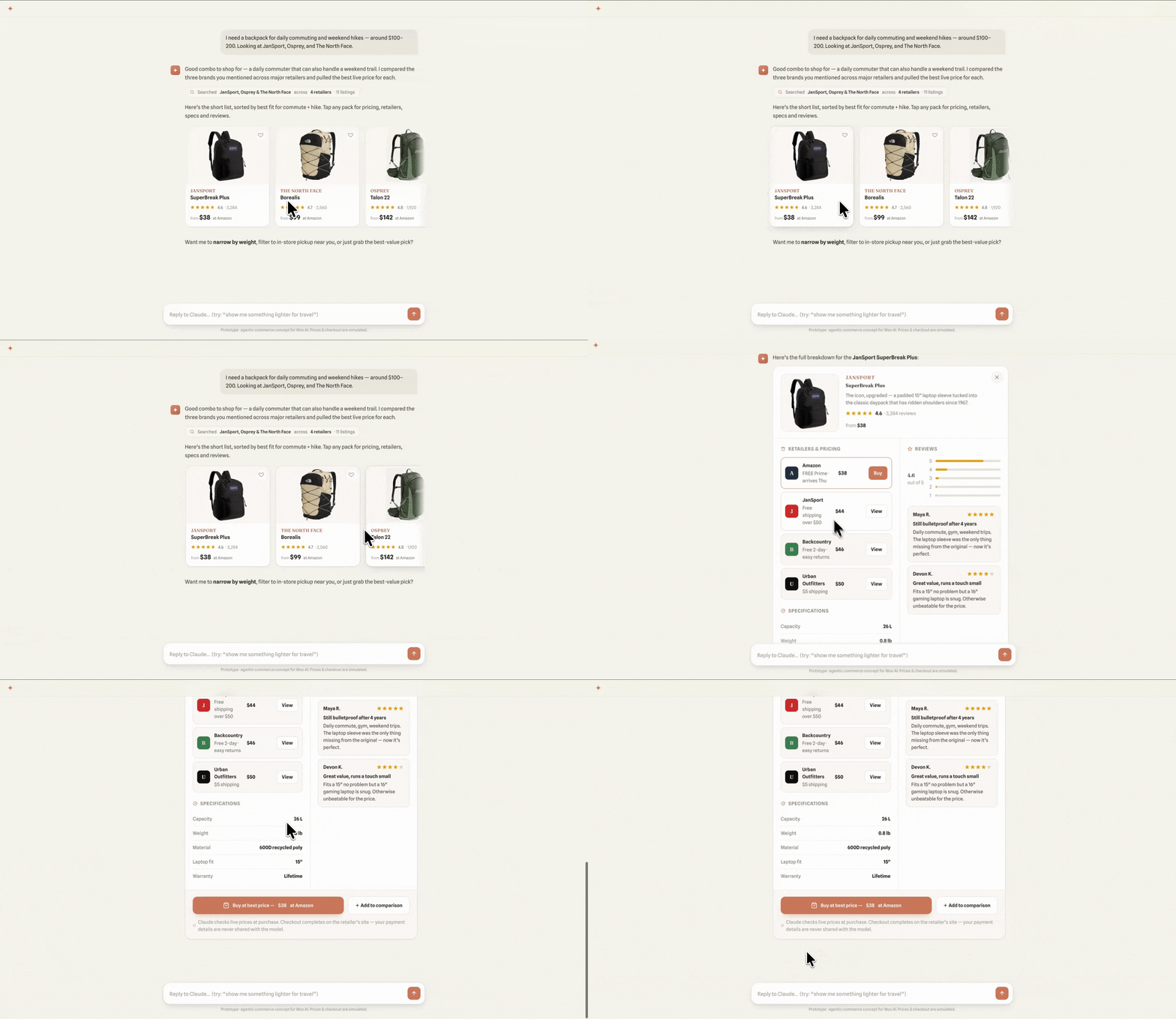
In the future state of agentic commerce, you’ll see shoppers setting preferences and letting the agent run, while it independently executes tasks and completes checkout via APIs.
At Woo, our role is to support the merchant as best we can to get their products listed and available for search and purchase by the shopper’s agents. The real challenge is:
How do we make a highly technical, machine-to-machine paradigm feel safe, controllable, and intuitive for an everyday merchant?
Design Principles for Agentic Commerce
- Prioritize machine-readability (and make it visual). AI agents don’t browse websites like humans, they read structured data from the backend. Considerations here include providing an “AI readiness” score or dashboard for a clear, visual indicator of product catalog health, and a preview of how the AI agent sees that data. This demystifies the structure and allows the merchant to see exactly what an algorithm is evaluating. Additionally, make sure that context is part of the catalog—blog posts, buying guides, FAQs, and reviews all determine sentiment and trust and should be linked to the product schema.
- Establish human guardrails for machine speed. As a merchant, even if you want to participate in autonomous commerce, you may fear losing control. AI agents shop fast and can query 50 product variations, pricing tiers, and delivery options in two seconds. To a firewall, this may look like a malicious scraper. UX considerations here include giving the merchant control over non-human traffic by allowing verified consumer agents to browse freely while applying a challenge (or retry-after) response to others, and enabling exclusions for high-fraud risk categories.
- Illuminate the invisible session. Because AI agents operate in a black box, merchants will naturally be skeptical. The sessions are “invisible” to the browser, there’s no cookie data, and no traditional checkout funnel analytics. Design considerations here include reimagining the analytics view to provide a new source tag for
Purchased via an AI agent, plus insights showing how agents are finding them (Gemini, ChatGPT, etc.). Also, if an automated transaction fails, or an agent abandons a cart, the merchant needs to know exactly why—in plain language.
Agentic Merchant Operations
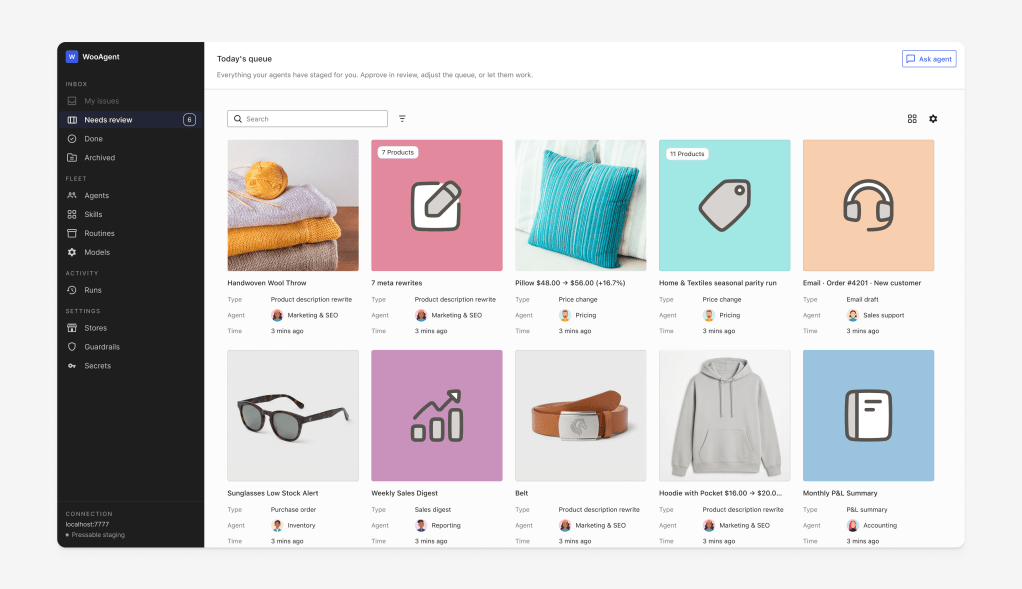
In scenario #2—AI workers operating for the merchant—there are two types of interactions to design for: Collaborative agents that you prompt to run things on your store (in a chat interface), and autonomous agents that run your store for you. These agents can be fully autonomous or human-in-the-loop, and we’re seeing more and more of them as the industry evolves.
As platforms like StoreClaw gain traction by selling outcomes rather than tools, the industry is transitioning from the “Copilot era” to the “Autopilot era.”
The challenge here is: how do you make AI work feel legible, controllable, and trustworthy to a store owner who wants to get the work done, not spend time managing?
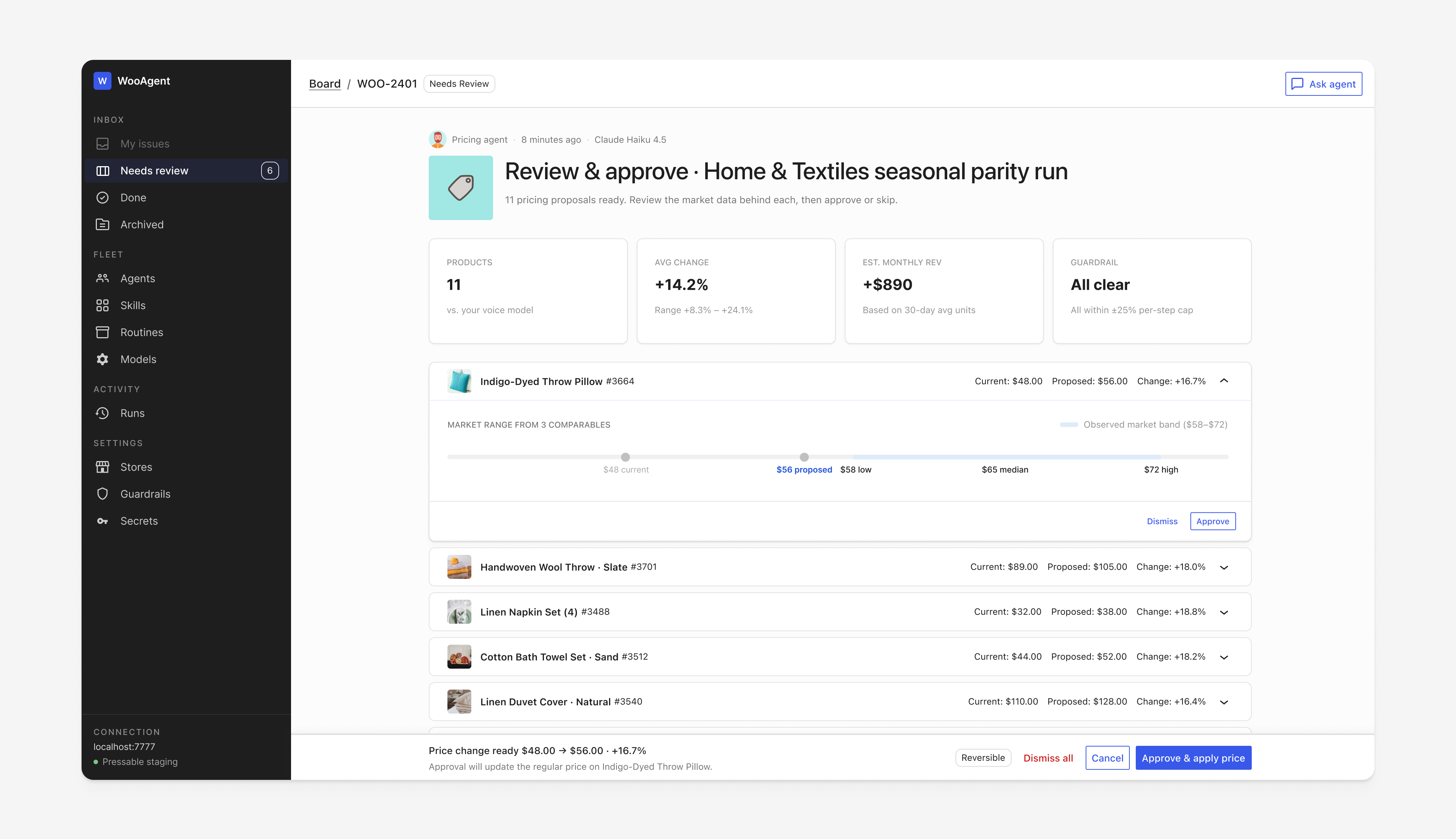
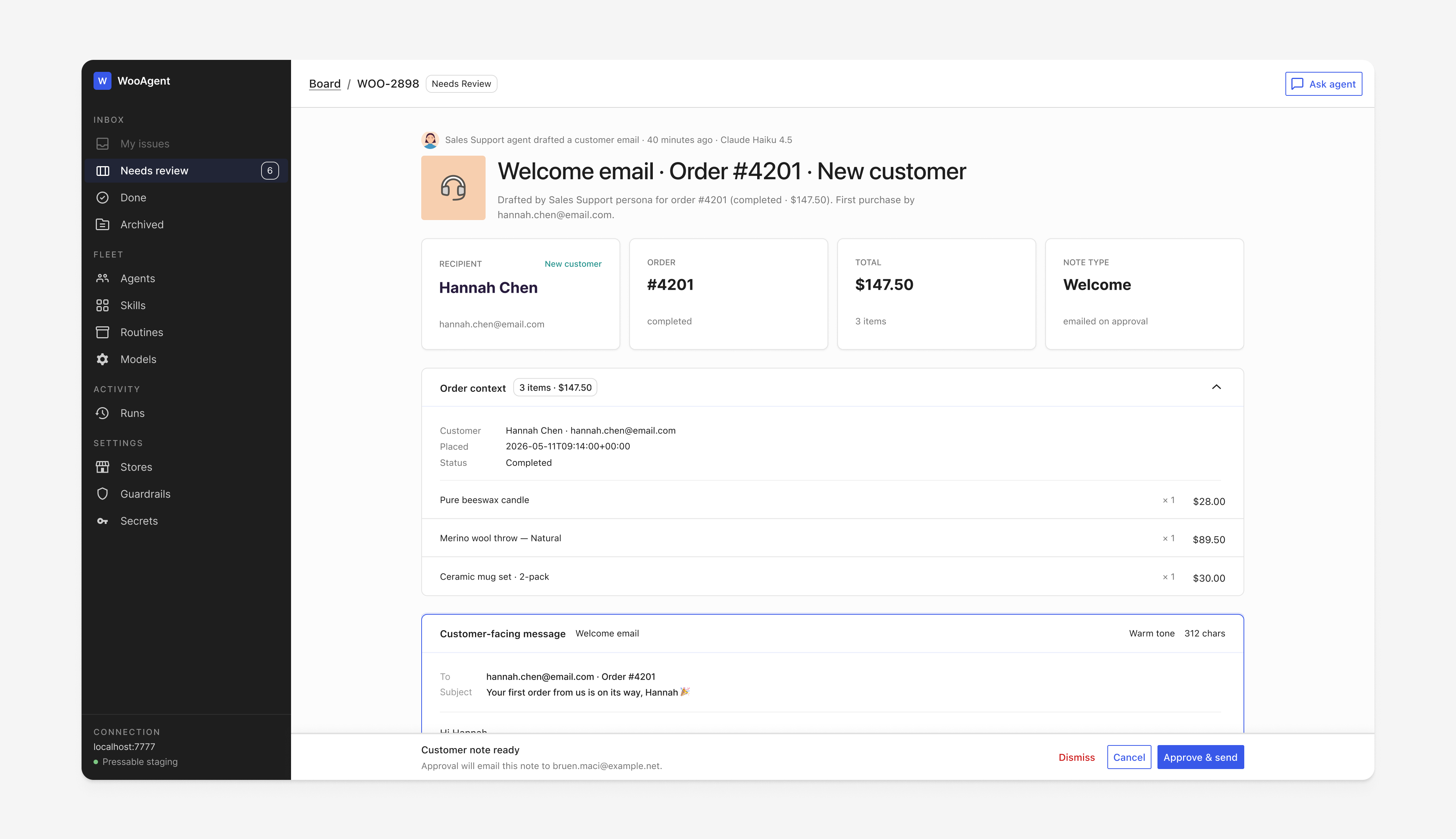
When we were designing and building WooAgent, a team of AI coworkers for your WooCommerce store, we wanted to present the agent proposals in a way that made it clear what changes the agent is proposing for the store, the reasoning why, and what will happen if you click approve. We also needed to instill confidence that any changes you make are reversible.
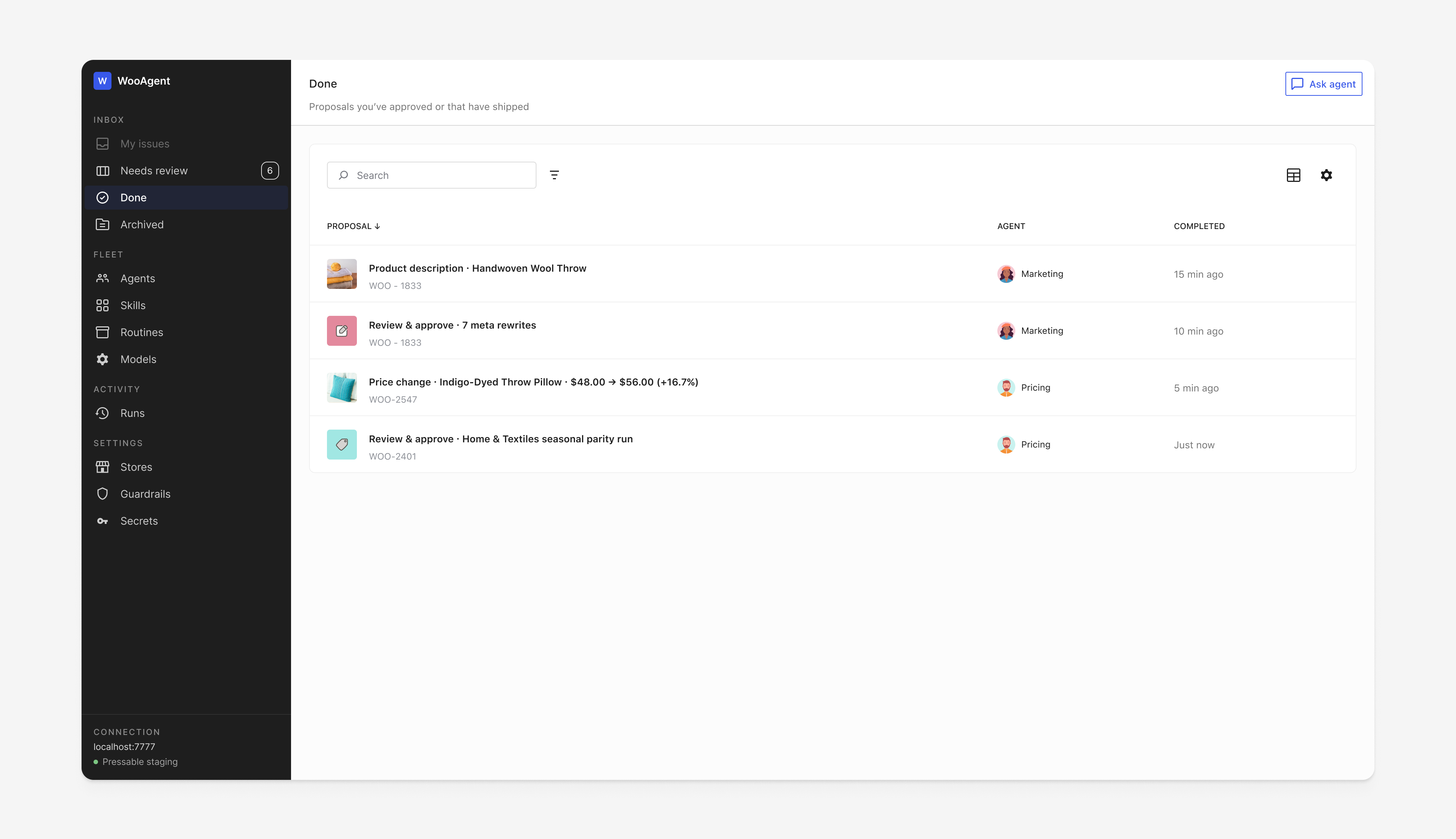
We grounded our work in the following design principles:
Design Principles for Autonomous Admin Agents
- Design the system layer, not the feature layer. In traditional products, you design features for humans to execute. In autonomous commerce, you’re designing a command center that monitors a system running in the background. The principle here is to move the UI focus from input actions to outcome reviews. The dashboard shouldn’t ask merchants to trigger a task, it should present the synthesized results of tasks (think executive briefing over a 15-minute morning coffee window) that have already been processed or that need review and approval.
- Group systemic actions into macro-proposals. Because agents are working across a wide range of proposals for marketing, inventory, reporting, and pricing, they can generate hundreds of micro-adjustments in one run. Presenting merchants with a raw spreadsheet of changes would cause approval paralysis. Use visual hierarchy to let the merchant scan the intent first, then expand to see the line items.
- Explain the “Why” over the “What.” Designing for trust means exposing the agent’s backend homework. A merchant will never click “Approve” out of blind faith, especially in high-risk areas like pricing or inventory replenishment. Every automated recommendation must include the underlying context and trigger. Instead of “Drop price of item X by 10%”, the UI should show the reasoning chain:
- Observation: Competitor price drop detected.
- Impact: Your listing’s conversion rate fell by 14% over the last 48 hours.
- Reasoning: Lowering the price by 10% restores your competitiveness while preserving an 18% net margin.
- Have a frictionless path to “Undo.” A big barrier to autonomous adoption is fear of irreversible chaos—for example, an agent accidentally setting a price to $0, or deleting high-ranking SEO tags. The path to “Undo” should be just as visible and frictionless as the path to “Approve.” If a merchant knows an action can be cleanly rolled back with a single click, anxiety drops significantly, and their willingness to trust the system goes up.
So, what word should we use besides “agent”?
If we start using specific, intentional language, our design frameworks and communication around the products we’re building will become instantly clearer. Here are some ideas.
Instead of building generic “agents”, we’re designing for two different user personas:
- The machine buyer: When designing for Agentic Commerce, we’re building the infrastructure that makes a merchant’s store a trusted, machine-readable data source for the customer’s automated shopping agent.
- The AI Coworker: When designing for Agentic Merchant Operations, we’re building a seamless, system-level executive briefing for a merchant’s digital fleet—their automated SEO specialists, inventory managers, and pricing analysts.
The choice of words here makes a difference. If we tell merchants they’re hiring an AI Coworker to handle their nightly catalog optimization—one that respects human guardrails, clearly explains its reasoning, and offers a frictionless “Undo” button—anxiety can turn into adoption.
As we navigate the autopilot era of 2026, our mission at Woo is to democratize these tools. By anchoring our product design in this radical transparency, machine-readability, and human-in-the-loop control, we can ensure that everyday merchants can adopt, benefit from, and even lead this agentic shift.


